Critical Strike CS: Online FPS
- 4.7
- Rating
- 100.00M
- Installs
- Free
- Price

 Analysis by App-foxy
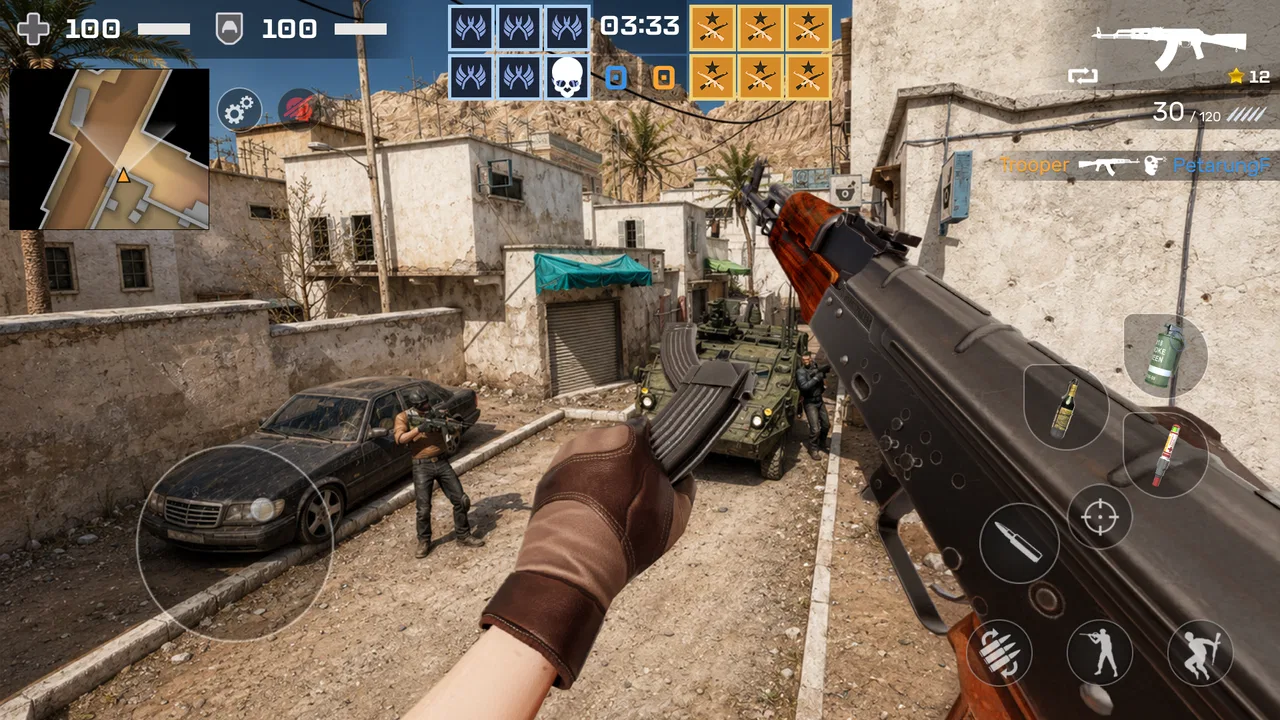
Critical Strike CS: Online FPS is the kind of mobile action game I open when I want a quick burst of competitive shooting rather than a long story or a complicated character-building system. Developed by VERTIGO GAMES, it puts the focus on multiplayer counter-terrorist battles, with compact matches that are easy to understand within minutes. The basic appeal is immediate: choose a side, enter the arena, aim carefully, and try to outplay the opponents in front of you.
My first impression is that the game is built around a very clear loop. I take the first shot, read the result, adjust my movement or aim, earn the satisfaction of a successful round, and then feel the pull to try again after the match ends. That structure is familiar to anyone who has played a competitive first-person shooter, but it works especially well on a phone because the game does not ask me to commit to a long campaign before the action begins.
The title is free to play and carries a Mature 17+ rating, so it is aimed at an adult audience that is comfortable with online combat. It has reached over 100 million installs and holds a 4.7 average from around 1.1 million ratings, which gives a useful indication of how broad its audience has become. Those figures do not automatically make it the right shooter for everyone, but they do suggest that finding active competition is part of the experience rather than an unusual bonus.
You May Also Like

 AccuWeather: Weather Radar
AccuWeather Review: A Quick, Clear Forecast for Everyday Decisions
For everyday plans, the best forecast is the one you can understand quickly. AccuWeather makes rain timing, radar, and local conditions easy to act on, with a few trade-offs.

 Hill Climb Racing
Why Hill Climb Racing Still Turns Crashes Into One More Run
A tiny car, a bumpy hill and one more upgrade: Hill Climb Racing keeps resurfacing because its simple chaos makes every near-miss feel personal.

 AliExpress - Shopping App
AliExpress Makes Global Shopping Feel Personal, but Shoppers Bear the Risk
AliExpress turns a global marketplace into a pocket-sized discovery engine. Its reach is useful, its shopping loop compelling, and its trade-offs easy to miss.

 Lords Mobile: Kingdom Wars
Lords Mobile Is a Kingdom-Building Routine, Not a Quick Match
A case-by-case verdict on the building, battles, device demands, and social commitments that make Lords Mobile rewarding for some players and exhausting for others.

 PDF Scanner app - TapScanner
TapScanner Makes Paperwork Easier to Capture, Check, and Share
TapScanner makes scanning with a phone feel less like a rescue operation and more like a dependable step in getting work done. Its capture tools are useful, though not flawless.

 Block Blast!
 Shows How Much a Puzzle Game Can Leave Out
A quiet grid game shows why puzzle players increasingly value instant clarity, repeatable skill and low-pressure play—and where the genre still needs to catch up.
More From Our News Desk
View All News


From the first shot to the next match
I use the first match less as a test of skill than as a chance to notice how the controls feel on my phone: whether aiming stays comfortable, movement is predictable, and I can react without fumbling. That small check helps separate a rough start from a setup that needs adjusting. Next, I look at the simple steps that can make a session feel more consistent.
The opening action is simple, but the controls decide everything
When I begin a match, the important decision is not whether I understand the objective. The game communicates its central idea quickly: move through the arena, watch likely angles, and win encounters against the opposing team. The real learning curve comes from translating familiar shooter habits to a touchscreen. Turning, aiming, firing, and repositioning all need to happen with enough accuracy that I do not fight the interface more than the enemy.
That makes the first few sessions more revealing than a store description can be. A player who already understands cover, sightlines, and patience will usually adapt faster than someone who simply runs toward every visible opponent. In my experience, the best early habit is to slow down just enough to check an angle before crossing it. Mobile controls reward deliberate movement because a rushed swipe can turn a promising engagement into a missed opportunity.
The game feels most approachable when I treat each encounter as a small decision rather than a race to fire first. I ask whether I have a clear view, whether I am exposed from another direction, and whether continuing forward is smarter than waiting. That mindset gives the action more texture. Even in a short match, I am not only reacting; I am constantly choosing how much risk to accept.
Players who expect a relaxed, offline shooter should know what they are installing. This is a competitive multiplayer game, so the quality of a session depends on the people on the other side and on my own willingness to concentrate. It is not the best fit for someone looking for a quiet game that can be paused whenever real life interrupts. For that use, a solo action title is usually more forgiving.
Why the feedback rhythm keeps me involved
The strongest part of the experience is the rhythm between action and feedback. A missed shot tells me that my aim, timing, or positioning needs work. A clean elimination confirms that a decision was correct. Being caught from an unexpected angle teaches me to check the route more carefully next time. That information arrives quickly, which makes improvement feel connected to something I just did rather than to a distant progression screen.
I like this immediacy because it gives even a short session a clear purpose. If I lose an exchange, I normally know what I want to change in the next one: hold the crosshair at a more useful height, avoid exposing too much of my body, or stop repeating the same approach. The game becomes more satisfying when I use defeats as practical notes instead of treating them as random bad luck.
There is also a useful difference between a close loss and a careless loss. A close loss can leave me eager to replay because I can imagine a small correction changing the result. A careless loss feels more frustrating, but it is still valuable if it exposes a habit such as reloading in an unsafe position or chasing an opponent too far. The short match structure makes those lessons easy to test immediately.
One non-obvious tip is to use the first moments of a match as a control check rather than spending them on reckless attacks. I pay attention to how quickly my aim moves, how comfortable the firing layout feels, and whether my device responds consistently. If the controls feel awkward, changing my grip or sensitivity before trying to compete seriously can matter more than any aggressive tactic. On a touchscreen, comfort is part of accuracy.
Small rewards matter because they close the loop
The reward in Critical Strike CS: Online FPS is not limited to winning. A good exchange, a better position, or a successful adjustment can provide a smaller sense of progress even when the final result is disappointing. That is important in a competitive game, because judging every session only by victory would make the experience unnecessarily harsh.
I find the game most rewarding when I set a narrow goal before starting. One session might be about avoiding the same exposed route. Another might focus on staying with teammates instead of wandering alone. A third might be about improving patience and refusing to fire until the target is properly lined up. These goals make the match feel productive even when the opposing team is stronger.
The free entry also lowers the barrier to trying the game. I can install it without paying upfront and decide whether the controls, pace, and competitive pressure suit me. However, free access does not mean the experience is free from commercial pressure. In-app purchases range from $0.49 to $209.99 per item, so I would approach the purchase system carefully and decide in advance whether I want to spend anything at all.
My advice is to treat purchases as optional until I understand what I genuinely enjoy about the game. Buying something early cannot fix a control layout that feels uncomfortable or a play style that does not suit me. The better test is to play enough matches to learn whether the core shooting loop is enjoyable on my particular device. If the basic action does not feel good, additional spending is unlikely to change that judgment.
The reset after defeat is part of the design
Every match eventually wipes the slate clean. A strong round does not guarantee that the next one will go well, and a poor opening does not permanently define the session. I appreciate that reset because it keeps the game focused on the next decision. There is no need to carry a bad exchange through an entire campaign or wait for a distant checkpoint before trying again.
At the same time, the reset can expose one of the game's main weaknesses: competitive repetition is not relaxing for everyone. If I play while tired or distracted, I make predictable mistakes, become impatient, and then start another match hoping to recover. That can create an unhelpful cycle where the desire to erase a loss leads to worse decisions. The game is better when I take a short break after several frustrating rounds instead of forcing one more attempt.
A realistic everyday use case is a short break between errands or during a commute where I have a stable connection and enough attention for a competitive match. I can get a complete burst of action without reserving an evening for it. But I would not choose it while waiting for an appointment if I might need to put the phone down at any moment. A sudden interruption can turn a manageable round into an unfair experience for teammates and opponents alike.
The reset also makes the title suitable for players who like experimenting. I can change my route, alter how aggressively I enter an area, or spend a match observing instead of chasing eliminations. Because the next round starts fresh, experimentation does not feel like permanently damaging a character or losing hours of progress. That freedom is one of the reasons I return after a disappointing result.
How it compares with other mobile shooters
Compared with large mobile shooters built around extensive progression, broad maps, or a long list of modes, Critical Strike CS: Online FPS feels more direct. Its identity is centered on the encounter itself: finding an opponent, reading the situation, and surviving the exchange. I prefer that focus when I want a concentrated competitive experience rather than a game that asks me to manage many systems before I reach the action.
The trade-off is variety and depth. Players who enjoy a substantial single-player campaign, detailed loadout planning, or a large open environment may find this format too narrow. A bigger shooter can offer more ways to spend time and more room to develop a personal play style. In return, it may also demand more storage, more attention, and a longer commitment per session. The better choice depends on whether I value immediacy or breadth.
It also differs from casual arcade shooters that are designed primarily around instant amusement. Here, the competitive context makes positioning and discipline more important. I cannot rely only on fast reactions if the opposing player has a better angle or catches me moving carelessly. That extra pressure is rewarding for players who like learning through repetition, but it can feel severe to anyone who wants a low-stakes distraction.
The developer, VERTIGO GAMES, has kept the central proposition recognizable over time, and the current version is 14.8500. The game supports devices running Android 7.1 or later, which makes it accessible to a broad range of Android users. Still, compatibility alone does not guarantee an ideal experience: screen size, touch response, device performance, and connection stability can all affect how fair and comfortable a competitive match feels.
Practical habits that improve a session
My first practical recommendation is to avoid changing too many control habits at once. If I adjust the layout, sensitivity, movement style, and approach to combat simultaneously, I cannot tell which change helped. I prefer to alter one element, play several matches, and keep the change only if aiming or movement becomes more natural. This method is slower than copying someone else's setup, but it produces a control scheme I can actually remember under pressure.
Second, I try to separate information gathering from attacking. Moving through an area is not automatically progress if I have no idea where an opponent could be. A brief pause near cover can reveal the direction of danger and prevent an unnecessary sprint into a firing line. This is particularly useful for new players who feel that every quiet moment means they are falling behind.
Third, I judge a weapon encounter by the quality of my position before blaming aim. If I am exposed from two directions, even excellent shooting may not save me. When I lose repeatedly, I ask whether I entered from the same route, stood in the same visible place, or pursued an opponent beyond safe cover. These questions are more actionable than simply deciding that another player was faster.
Finally, I keep sessions short when my attention drops. The game’s action is easy to start, which is a strength, but that same convenience can encourage automatic replays. A reset should invite a fresh decision, not become a reflex. Stopping after a good match can be just as sensible as stopping after a bad one, especially if I want to remember what worked.
Who should play and who should skip it
I would recommend this game to someone who enjoys competitive first-person shooting, wants a free way to test a mobile multiplayer arena, and likes improving through repeated short encounters. It is especially appealing if the idea of learning angles, movement, and timing sounds more interesting than collecting a large number of story rewards. The broad install base and high average rating also make it a reasonable starting point for a player curious about this style of mobile action.
I would be more cautious about recommending it to a child because of the Mature 17+ rating, or to anyone who dislikes online competition and touch controls. Players who need a game that works well in brief interruptions should also look elsewhere. A pause-friendly puzzle game or offline action title may be a better companion for uncertain schedules.
It is also not the right choice for someone who wants a highly tactical team simulator with slow planning, or for a player who expects a cinematic campaign. The game’s pleasure comes from the repeatable combat loop, not from a long narrative journey. Knowing that before installing it prevents the most common disappointment: expecting a different genre because the word “shooter” covers many very different experiences.
My verdict on the action loop
After spending time with Critical Strike CS: Online FPS, I see its appeal in the clean sequence of action, feedback, reward, and reset. I enter a match with a simple objective, learn from each exchange, enjoy the moments when a decision works, and receive another chance when the round ends. That cycle is familiar, but the game makes it easy to access without turning every session into a major time commitment.
Its limitations are equally clear. Touchscreen precision can take adjustment, online competition can be demanding, and the wide range of in-app purchase prices means I would keep spending under control. The game also cannot replace a larger shooter for players who want extensive modes, narrative content, or deeper long-term systems. Those are not small details; they determine whether the compact arena format feels focused or repetitive.
For me, the deciding question is simple: do I enjoy the next encounter enough to learn from the last one? When the answer is yes, the reset becomes an invitation rather than a chore. The best reason to play is not the promise of an effortless win, but the tight feedback that makes one more carefully chosen move feel worthwhile. If that sounds like your kind of mobile action, Critical Strike CS: Online FPS is worth trying for its free core experience, provided you approach the Mature 17+ rating, competitive pressure, and optional purchases with the right expectations.
FAQs for Critical Strike CS: Online FPS
01What is Critical Strike CS: Online FPS?
Critical Strike CS: Online FPS is a fast-paced multiplayer first-person shooter inspired by classic counter-terrorism games. It focuses on short competitive rounds, team-based combat, bomb-related objectives, and familiar weapon handling. The game is designed for mobile devices, offering quick matches that are easy to start but require practice to master aiming, movement, recoil control, and map positioning.
02Can I play Critical Strike CS: Online FPS offline?
The main experience is built around online multiplayer, so an internet connection is generally required to join competitive matches and play against other users. Offline access may be limited to certain training or practice features, depending on the version installed and current game updates. Players should use a stable Wi-Fi or mobile data connection to reduce lag, disconnections, and matchmaking problems.
03Does the game support multiplayer modes and competitive matches?
Yes, multiplayer is the central part of Critical Strike CS: Online FPS. You can compete in team-based matches where communication, coordinated attacks, defensive positioning, and objective control are important. Match availability and specific modes can change with updates, but the game is primarily aimed at players who enjoy quick online rounds rather than a long single-player campaign or story-driven progression.
04Is Critical Strike CS: Online FPS free to download and play?
The game is generally available as a free download, allowing players to install it and access its core shooting and multiplayer features without paying upfront. However, free-to-play games commonly include optional in-app purchases, advertisements, cosmetic items, weapon-related content, or other upgrades. Before downloading, check the store listing and your device settings so you understand possible costs and purchase requirements.
05What devices and skills are needed to play comfortably?
Critical Strike CS: Online FPS works best on a relatively modern Android or iOS device with enough free storage, updated system software, and a stable connection. Smooth performance depends on your phone or tablet’s processor, memory, graphics capability, and background activity. New players should also expect a learning curve, since accurate touch controls, fast reactions, map knowledge, and teamwork strongly affect match results.
Pros
- Fast-paced matches are easy to start and usually last only a few minutes.
- Simple controls make the game approachable for mobile FPS newcomers.
- Multiple weapons offer useful variety for different combat styles.
- Competitive rounds reward teamwork
- positioning
- and accurate aiming.
- The classic counter-terrorist format feels familiar to FPS fans.
Cons
- Random teammates can make coordinated objectives frustrating.
- Small screens may limit precision during intense firefights.
- Progression and weapon options can feel repetitive over time.
- Online performance depends heavily on connection quality and server stability.
- Frequent matches may drain battery quickly on older devices.

Critical Strike CS: Online FPS
Gallery